
T
Loading…
Loading…
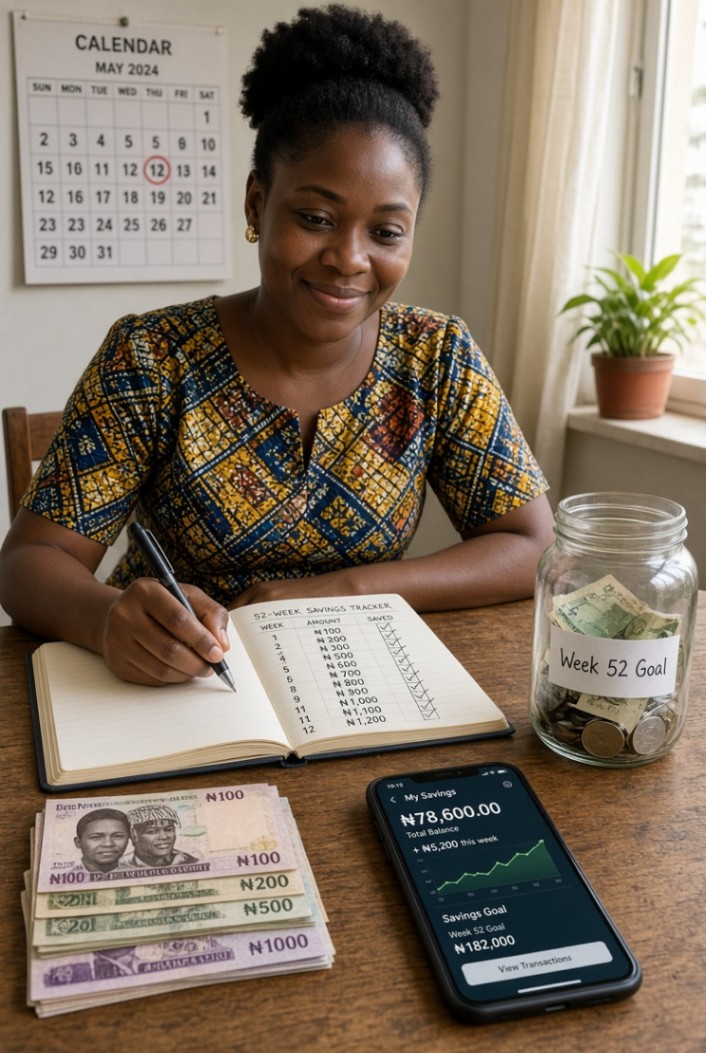
The 52-week savings challenge is a simple plan where the amount saved changes each week. In the traditional version, you save ₦1 in week one, ₦2 in week two, and continue adding ₦1 weekly until week 52. That produces ₦1,378 by the end—too small to be meaningful for many people in Nigeria.
A naira-based version uses a more practical weekly starting amount, such as ₦500, ₦1,000, or ₦2,000. The result depends on the starting amount, your income pattern, inflation, bank charges, and whether you can keep the money separate from everyday spending.
The challenge can work as a savings structure, but it is not automatically suitable for every income level. A flexible version is often easier to maintain than a rigid plan that becomes stressful after a few difficult weeks.
The standard escalating formula is:
$ \text{Weekly saving} = \text{starting amount} \times \text{week number} $
If the starting amount is ₦500:
The total is calculated as:
$ ₦500 \times \frac{52 \times 53}{2} = ₦689,000 $
That final amount may look attractive, but the later weekly payments can become difficult. Someone following a ₦1,000 starting plan would need to save ₦52,000 in week 52 and ₦1,378,000 across the year.
This is why the traditional “increase every week” format does not automatically translate well to Nigerian households with irregular salaries, school expenses, transport costs, rent, family responsibilities, or fluctuating business income.
The table below shows the total amount produced by different starting amounts.
| Starting amount | Week 1 | Week 26 | Week 52 | Total after 52 weeks |
|---|---|---|---|---|
| ₦100 | ₦100 | ₦2,600 | ₦5,200 | ₦137,800 |
| ₦250 | ₦250 | ₦6,500 | ₦13,000 | ₦344,500 |
| ₦500 |
10 Thrift Finds Under ₦2,000 You Need to See
How to Recreate a Celebrity Look With Thrift Pieces
Thrift Date Night Outfits That Don’t Look Cheap
Thrift Outfit Ideas for Campus: Stylish School Looks on a Budget
Thrifted Street Style: Outfits Spotted on Lagos Streets
15 Thrifted Outfit Inspo Looks for This Week
Have something to give away or sell?
Post your first listing — it only takes a couple of minutes. Or browse listings near you.
| ₦500 |
| ₦13,000 |
| ₦26,000 |
| ₦689,000 |
| ₦1,000 | ₦1,000 | ₦26,000 | ₦52,000 | ₦1,378,000 |
| ₦2,000 | ₦2,000 | ₦52,000 | ₦104,000 | ₦2,756,000 |
These totals are mathematical examples, not guaranteed outcomes. A person whose income changes monthly may find a fixed weekly target less practical than a monthly or percentage-based system.
The challenge works when the amount matches the person’s actual cash flow and the savings are kept separate. It becomes less useful when the target is copied from an online chart without checking transport, food, rent, school fees, data, debt repayments, or family obligations.
A simple test is to compare the final six weeks with your normal income pattern. If the plan requires ₦20,000, ₦25,000, or ₦50,000 per week near the end, consider whether those amounts are realistic during low-income periods.
You save the same amount every week.
| Weekly amount | Approximate yearly total |
|---|---|
| ₦500 | ₦26,000 |
| ₦1,000 | ₦52,000 |
| ₦2,000 | ₦104,000 |
| ₦5,000 | ₦260,000 |
| ₦10,000 | ₦520,000 |
This format is easy to track and does not create a large payment at the end.
You increase the payment every week. This follows the popular 52-week format but creates the largest payments at the end.
For a ₦500 starting amount, the yearly total is ₦689,000. For a ₦1,000 starting amount, it is ₦1,378,000.
You begin with the largest amount and reduce it each week. For a ₦500 plan, week one is ₦26,000 and week 52 is ₦500.
The total remains ₦689,000, but the early payments are larger. This can be useful for someone who receives larger income at the beginning of a cycle, but it may create pressure immediately.
Many Nigerians do not receive identical income every week. Traders, freelancers, students, casual workers, commission-based workers, and small business owners may have strong and weak periods.
A flexible challenge can use three levels:
For example:
| Week type | Deposit |
|---|---|
| Difficult week | ₦500 |
| Ordinary week | ₦2,000 |
| Strong income week | ₦5,000 |
The aim is to maintain the habit without treating every week as financially identical. Keeping a written record prevents confusion when deposits vary.
A clear purpose makes the challenge easier to measure. Examples include:
A ₦52,000 target requires a different plan from a ₦500,000 target. Write the target and the intended date before choosing the weekly amount.
For a fixed weekly plan:
$ \text{Weekly amount} = \frac{\text{target amount}}{52} $
For example:
$ \frac{₦104,000}{52} = ₦2,000 $
A person targeting ₦104,000 could save ₦2,000 per week rather than starting at ₦2,000 and increasing the amount every week.
For a monthly approach:
$ \frac{₦104,000}{12} \approx ₦8,667 $
This can be rounded according to the person’s cash-flow calendar, such as ₦8,500 in some months and ₦9,000 in others.
Someone paid monthly may find a monthly transfer easier to track. Someone receiving daily sales may record small deposits until the weekly total is reached.
Possible schedules include:
The important calculation is the total deposited, not whether the payment follows a particular social-media template.
Secondhand fashion can connect with a savings challenge because it offers ways to reduce clothing costs, extend garment use, and recover value from items that are no longer worn. Second-hand clothing consumption is a known driver of the circular economy in many African markets, though the trade also faces challenges regarding waste management and logistics.
A practical example:
That ₦13,000 is not automatically “savings.” It becomes savings only if it is transferred or set aside instead of being spent elsewhere.
The same principle applies when clearing a wardrobe. Selling a clean, accurately described item can recover part of its original cost. Donation can also extend an item’s useful life, although donated clothing is not the same as cash savings.
Before purchasing or listing an item, check:
Circular-fashion research commonly treats reuse and repair as ways to delay disposal, although circular fashion still requires responsible handling of quality, waste, and logistics.
A simple record can include:
| Week | Planned amount | Amount deposited | Date | Running total |
|---|---|---|---|---|
| 1 | ₦2,000 | ₦2,000 | 6 January | ₦2,000 |
| 2 | ₦2,000 | ₦2,000 | 13 January | ₦4,000 |
| 3 | ₦2,000 | ₦1,000 | 20 January | ₦5,000 |
If a week is missed, record it instead of deleting it. The record shows whether the issue is an unrealistic target, irregular income, unexpected costs, or an account-access problem.
Digital transfers can create bank charges depending on the account and transaction type. Cash envelopes can avoid some transfer costs but introduce loss and security risks. A separate account or regulated savings product may provide clearer records, but the terms, withdrawal rules, and charges need to be read before use.
A ₦1,000 escalating plan sounds manageable at the start, but the final weekly deposit reaches ₦52,000. Calculate the last payment and the total before starting.
Savings targets compete with real expenses. A challenge becomes difficult when it assumes that rent, food, transport, data, school costs, and family obligations will never change.
Borrowing to avoid missing a weekly deposit changes the cost of the challenge. A missed deposit is easier to understand than a growing repayment obligation.
A target planned far in advance may buy less later if prices rise. For example, a clothing budget that covered a complete outfit at the start of a challenge may cover only selected items later. Keep the target connected to current prices rather than relying on an old estimate.
If the money remains in the same wallet used for food, airtime, transport, and online purchases, tracking becomes harder. Separate records and clear labels reduce accidental spending.
Use this checklist before beginning:
Fraud prevention is especially important in peer-to-peer transactions. Nigeria’s Federal Competition and Consumer Protection framework provides consumer-protection institutions and rules, but a savings challenge does not remove the need to verify recipients, sellers, payment details, and transaction records. For clothing, shoes, bags, hair, jewellery, and accessories, safety practices include clear descriptions, cautious communication, and avoiding pressure to pay before details are confirmed.
If the challenge includes selling unused clothes, shoes, bags, hair, jewellery, or accessories, Threddo can be used to create a direct listing and communicate with interested buyers through its WhatsApp-first marketplace. Review the platform’s safety guidance and browse relevant listings before arranging a transaction.
Consider a student with a target of ₦78,000 over 52 weeks. A fixed plan would require:
$ \frac{₦78,000}{52} = ₦1,500 $
The student could record ₦1,500 weekly, or divide it into three deposits of ₦500. During a holiday period with additional income, the student could deposit ₦3,000 and reduce later deposits while keeping the yearly target unchanged.
This approach avoids the final-week shock created by an escalating plan. It also makes the challenge easier to combine with secondhand clothing purchases, transport expenses, and school-related costs.
The 52-week savings challenge can work in naira when the amount is calculated from a realistic target, income schedule, and expense pattern. Fixed or flexible deposits may be easier to maintain than a traditional escalating plan, especially when the final weeks require large payments.
Secondhand shopping and resale can support a savings goal when price differences or recovered item value are deliberately recorded and set aside. The challenge is a tracking method, not a guarantee that money will accumulate without regular deposits and review.
This article is for educational purposes only and does not constitute professional advice. Always follow safe trading practices and use your own judgement.